
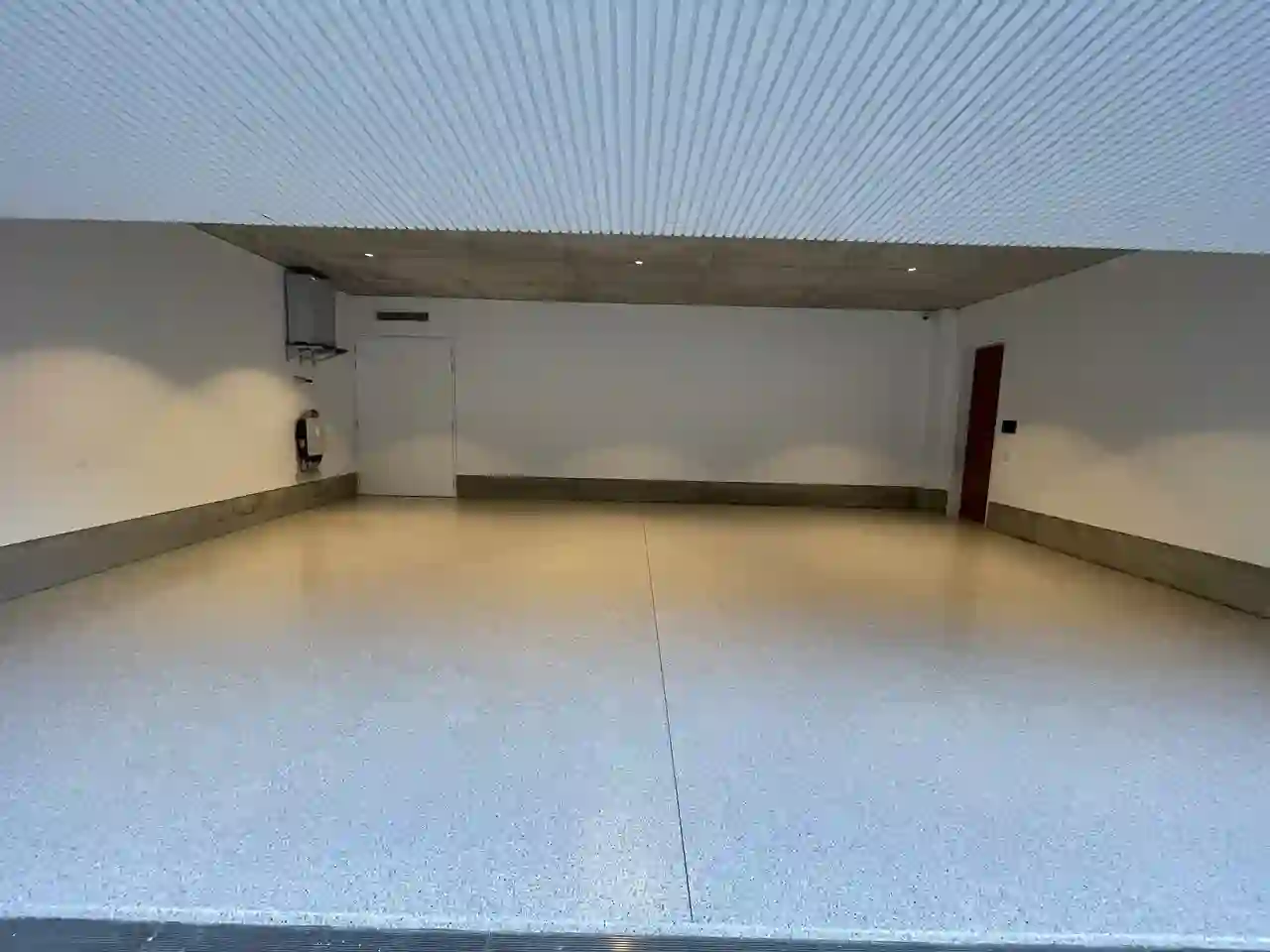
One of the most common questions we get is: “How much does epoxy garage flooring cost?” The honest answer is — it depends. Every garage is different, every slab is different, and every job is priced on its own merits. This guide explains exactly what drives the cost of an epoxy floor in Melbourne, so you can understand any quote you receive and make a confident, informed decision.
Garage size & shape
Larger areas and irregular shapes affect labour and material quantities
Product system grade
The biggest price variable — professional systems vs retail-grade differ dramatically
Surface preparation
Slab condition, moisture, cracks, and existing coatings all affect prep cost
Finish type
Solid colour, flake, metallic, and quartz systems each carry different material costs
Walk into any conversation about epoxy garage floor pricing in Melbourne and you’ll hear wildly different numbers. That’s not anyone pulling figures out of thin air — it’s because the cost of a properly installed epoxy floor is genuinely variable. The condition of your concrete slab, the size of the space, the product system used, and the experience of the installer all move the price significantly.
What this guide won’t do is give you a generic price range to anchor on before you’ve had your garage assessed. What it will do is explain every factor that goes into a professional quote, so you can understand why quotes differ — and more importantly, why the cheapest quote is rarely the best one.
Why epoxy garage floor quotes vary so much in Melbourne
Two homeowners on the same street can receive quotes that are hundreds — sometimes thousands — of dollars apart for what seems like the same job. Here’s why that happens, and why the difference is almost never just profit margin.
The variation almost always comes down to one or more of the following: the grade of product being used, the thoroughness of surface preparation, or the experience and equipment of the installer. A quote that seems surprisingly low is almost always cutting corners in at least one of these areas — and those corners show up in the finished floor within a year or two.
The key insight: An epoxy floor that fails in two years and needs to be redone costs significantly more over time than one that’s done properly once. When comparing quotes, the relevant number is the cost per year of reliable performance — not the upfront price.
The 5 factors that determine your epoxy floor cost
1. The size and layout of your garage
The square meterage of your floor is the starting point for any quote. But size isn’t just about total area — layout matters too. A standard rectangular double garage is straightforward to coat. A garage with alcoves, step-downs, built-in storage plinths, support columns, or tight access points takes more time and skill to execute cleanly.
Larger jobs do typically have a lower cost per square metre because the fixed setup costs — equipment transportation, grinding machine setup, material mixing — are spread across more area. But always ask for a total job price rather than a per-m² rate, as the latter can obscure the real scope of the work.
2. Product system and grade — the most important variable
This is where the biggest cost differences come from, and where most homeowners are surprised when they dig into what they’re actually getting. There are fundamentally different tiers of epoxy products:
| PRODUCT TIER | TYPE | TYPICAL LIFESPAN UNDER VEHICLE TRAFFIC | USED BY |
|---|---|---|---|
| Budget | Water-based, low solids | 1–3 years | DIY kits, cheap operators |
| Mid-grade | Solvent-based epoxy | 3–7 years | Trade-grade installs |
| Professional | 100% solids epoxy + polyurethane topcoat | 10–20+ years | Specialist installers only |
Hardware store epoxy kits use water-based, low-solids formulas that are genuinely easy to apply but are not engineered to handle daily vehicle movement, hot tyre pick-up, or the weight loading of a parked car. They degrade quickly — often peeling or lifting within a couple of years — even when applied correctly.
Professional-grade 100% solids epoxy systems are not available in retail stores. They require industrial application equipment and trained installers. They form a significantly harder, thicker, more chemically resistant surface — and they’re what separates a floor that lasts two years from one that lasts twenty.
The product system accounts for a large portion of any epoxy quote. When you see a very low price, the first question to ask is: what product are you actually using?
3. Surface preparation — the make-or-break factor
Surface preparation is the single most important factor in whether an epoxy floor succeeds or fails — and it’s the step most commonly skimped on by budget operators. This is also why two quotes for the same garage can look very different: proper prep is labour-intensive and requires industrial equipment that cheaper operators may not have or choose not to use.
Professional prep involves diamond grinding the concrete surface to mechanically open the profile and create the bond key the epoxy needs to adhere properly. This cannot be substituted with acid etching, which is insufficient for most Melbourne slabs and is not accepted as adequate preparation under professional-grade product specifications.
The condition of your existing concrete slab also significantly affects preparation time and cost:
| ● | Good condition, no damage: | Standard diamond grinding and profiling. The most straightforward scenario. |
| ● | Minor cracks or surface chips: | Crack filling and spall repair is required before coating. Small issues addressed properly at this stage prevent bigger problems in the finished floor. |
| ● | Oil or chemical contamination: | Oil-contaminated concrete requires degreasing treatment and extended prep time. Oil that penetrates deeply into the slab can significantly complicate the job. |
| ● | High moisture content: | Moisture beneath or within the slab is epoxy’s worst enemy. Professional installers test for moisture vapour emission before any coating goes down. Where moisture is present, a vapour barrier primer is essential — not optional. Skipping this leads to bubbling, lifting, and delamination. |
| ● | Existing paint or prior coating: | Any previous coating must be fully removed before a new system is applied. Epoxy cannot bond reliably over another coating. Removal adds time and cost depending on the type and coverage of the existing material. |
Melbourne-specific note: Melbourne’s clay-heavy soils and significant seasonal temperature swings create more moisture movement in concrete slabs than many other Australian cities. Moisture testing is not a formality here — it’s a genuine necessity on a high proportion of Melbourne jobs, particularly in older homes and areas with high water tables.
4. Finish type and decorative system
The decorative finish you choose affects both material cost and application time. Here’s how the most popular options compare:
| FINISH TYPE | DESCRIPTION | COST IMPACT |
|---|---|---|
| Solid colour | Single pigmented base coat + clear topcoat | Base level |
| Vinyl flake / chip | Decorative colour flakes broadcast into wet epoxy — most popular in Melbourne garages | Moderate increase |
| Full flake coverage | 100% broadcast for maximum grip and texture concealment | Higher increase |
| Metallic / marbled | Pigment manipulation for granite or marble visual effect | Significant increase |
| Quartz / sand aggregate | High-grip surface for wet-area or commercial requirements | Moderate increase |
Flake epoxy systems are by far the most popular choice for Melbourne residential garages. They hide minor surface imperfections, deliver excellent slip resistance, and come in dozens of colour combinations — while sitting in a mid-range cost bracket that most homeowners find good value for the result.
5. Site access and job-specific conditions
Some factors specific to your property can affect the complexity — and therefore the cost — of an otherwise standard job. These include restricted access (narrow driveways that limit equipment movement), step-downs or level changes within the floor area, built-in benches or cabinetry that need to be worked around, and multi-storey buildings where equipment access via lift is required.
A professional installer will identify all of these during an on-site assessment and factor them into the quote upfront — so there are no surprises once the job starts.
Get your free on-site quote
We visit your garage, assess your slab, discuss your finish options, and give you a detailed written quote — specific to your floor, not a generic estimate. No call-out fee, no obligation.
What a professional epoxy quote should always include
One of the clearest ways to assess the quality of an epoxy operator is to look at what their quote actually covers. A legitimate, professional quote is detailed and explicit — not a single line-item number. Every step below should either be listed in the quote or explained to you before you sign anything.
On-site assessment before quoting
No professional should quote your garage without visiting it first. A phone or online quote cannot account for slab condition, moisture, access, or the specific preparation your floor needs. If you’re being quoted without a site visit, the price is a guess — and the installer has no commitment to what’s actually required.
Diamond grinding and concrete profiling
The surface must be mechanically opened using industrial diamond grinders to create the bond profile epoxy needs. This is standard in professional installations and cannot be substituted. If a quote doesn’t mention grinding — or proposes acid etching instead — the preparation is inadequate for a lasting result.
Moisture testing
Moisture vapour emission from the slab is tested before any coating is applied. This step is non-negotiable in Melbourne, where slab moisture levels are a common issue. A moisture barrier primer is applied where needed. Any installer who skips this is setting up the job — and your floor — to fail.
All existing cracks, chips, and surface defects are filled and repaired before any coating is applied. Epoxy conforms to the surface beneath it — it doesn’t hide structural issues. Repairs done properly at this stage are what prevent weak spots from appearing in the finished floor.
Primer coat
A low-viscosity primer penetrates the concrete and creates the chemical anchor layer for the epoxy system. This is a separate coat from the epoxy base and is critical to adhesion on properly prepared surfaces.
Epoxy base coat (100% solids)
The pigmented epoxy base coat forms the body of the system. In professional installations this is a 100% solids formulation — no water or solvents, maximum film build, maximum durability. This is not the same product available in hardware stores.
Vinyl flake, quartz aggregate, or metallic pigment is broadcast into the wet base coat to create the chosen finish. Full-broadcast coverage provides the highest level of grip and the most uniform decorative result.
Clear polyurethane or polyaspartic topcoat
The final protective layer provides UV stability, abrasion resistance, and long-term gloss. Without a quality topcoat, the epoxy base will UV-yellow and wear down prematurely. This coat is what determines how the floor looks and performs years down the track.
Written workmanship warranty
A reputable installer stands behind their work in writing. If a quote doesn’t include a warranty — or the installer can’t tell you clearly what their warranty covers — that’s a significant red flag.
| ⚠ | Quote provided over the phone without a site visit. | A professional cannot accurately price your job without seeing the concrete, measuring the space, and assessing the slab condition. Phone quotes are guesses. |
| ⚠ | No mention of the surface preparation method. | Ask specifically: will diamond grinding be used? If the answer is acid etching only, or if the question draws a blank, the prep is inadequate. |
| ⚠ | Moisture testing not mentioned. | In Melbourne, this is essential — not optional. An installer who doesn’t raise it has either never encountered the issue or doesn’t want you to think about it. |
| ⚠ | No written warranty offered. | Professional workmanship comes with a warranty. If there’s nothing in writing, the installer isn’t confident in the result. |
| ⚠ | Cash only, no written quote. | Always insist on a detailed written quote specifying the product system, preparation method, number of coats, and any exclusions. This protects you if the result doesn’t match what was discussed. |
| ⚠ | Vague product description. | Ask specifically: what epoxy system are you using? What is the solids content? A professional will answer clearly. An evasive answer usually means a retail-grade product is being used at a professional-grade price. |
DIY epoxy kits vs professional installation: understanding the real difference
Hardware store epoxy kits look appealing on the shelf. They’re straightforward to apply, and the upfront cost is a fraction of professional installation. But the comparison isn’t as straightforward as it appears — and the gap widens dramatically over time.
| FACTOR | DIY KIT | PROFESSIONAL INSTALLATION |
|---|---|---|
| Product type | Water-based, low solids | 100% solids epoxy system |
| Lifespan under vehicle traffic | 1–3 years typical | 10–20+ years |
| Surface preparation | Acid etch only (insufficient) | Diamond grinding + moisture test |
| Crack and spall repair | Not included | Included as part of prep |
| Moisture protection | None | Tested and treated where needed |
| Topcoat included | Typically not | UV-stable polyurethane or polyaspartic |
| Warranty | None | Written workmanship warranty |
| Long-term value | Multiple redos over time | Done properly once |
The long-term picture: A DIY floor that needs redoing every two to three years — including your time, the cost of materials, and the disruption — often ends up costing more than a single professional installation over a 10-year period. And the professional result looks significantly better throughout.
Does epoxy flooring add value to your Melbourne property?
Consistently yes — and often more than homeowners expect. A polished, well-finished garage floor signals careful ownership and is noticed by buyers, particularly in the mid-to-upper end of the Melbourne market where presentation detail matters during inspections.
Melbourne real estate professionals consistently note that finished garages — with sealed floors, good lighting, and organised storage — contribute meaningfully to buyer perception and appraised value. For homeowners in Brighton, Camberwell, Glen Waverley, and the outer growth corridors where large-format garages are the norm, this impact is especially significant.
Beyond sale value, there’s the day-to-day benefit of a garage that’s genuinely easy to clean, resistant to oil and chemical spills, and pleasant to spend time in — whether you use it as a workshop, gym, or simply a place to keep your car.
Suburb note: Epoxy flooring tends to add the most relative value in areas where large-block homes and double or triple garages are common — Brighton, Toorak, Camberwell, Glen Waverley, Berwick, Narre Warren, and the Wyndham and Casey growth corridors.
How to prepare for your on-site epoxy quote
A well-prepared homeowner gets a more accurate quote — and is less likely to encounter variations after the job starts. Before your installer arrives, here’s what to have ready:
| ● | Clear the garage completely. | Every installer needs full access to the floor. Move vehicles, shelving units, stored items, and anything that sits on the concrete. Some operators charge a delay fee if the site isn’t ready on arrival. |
| ● | Note and photograph any existing damage. | Point out cracks, chips, staining, or areas of existing coating to the installer. Documenting them before the visit gives you a reference to confirm they’ve been addressed in the prep. |
| ● | Know your rough dimensions. | Having a sense of your floor area means you can quickly verify whether a quote is in the right ballpark for your space. |
| ● | Have a finish preference in mind. | Browse flake colour options, metallic finishes, or solid colours before the visit. A clear preference speeds up the consultation and allows for an accurate material cost. |
| ● | Prepare questions about the product. | Ask specifically what epoxy system will be used, what the preparation process involves, and what the warranty covers. How an installer answers these questions tells you as much as the quote itself. |
| ● | Get at least two written quotes. | Not to find the cheapest option — but to compare what’s actually included. A detailed quote that specifies prep method, product system, coat count, and warranty is from a professional. A single-line quote is not. |
We service all Melbourne suburbs — with free on-site quotes
Our pricing is based on your specific garage, assessed in person. We service all Melbourne metropolitan suburbs, including:
Inner and middle ring: South Yarra, Hawthorn, Camberwell, Brighton, St Kilda, Port Melbourne, Richmond, Fitzroy, Prahran, Armadale, Malvern, Glen Iris, Kew, Balwyn, Carlton.
Eastern suburbs: Box Hill, Doncaster, Ringwood, Mitcham, Croydon, Lilydale, Wantirna, Vermont, Blackburn, Nunawading, Mooroolbark.
South-eastern suburbs: Dandenong, Berwick, Narre Warren, Cranbourne, Frankston, Pakenham, Officer, Hallam, Springvale, Rowville.
Northern suburbs: Bundoora, Epping, Preston, Coburg, Reservoir, Lalor, Thomastown, Mill Park, South Morang, Craigieburn.
Western suburbs: Footscray, Sunshine, Werribee, Hoppers Crossing, Altona, Laverton, Williamstown, Point Cook, Tarneit, Truganina.
No call-out fee. No obligation. We come to you, assess your garage, and give you a detailed written quote specific to your floor — not a generic estimate. Book your free assessment today.
Frequently Asked Questions
How much does epoxy garage floor coating cost in Melbourne?
Epoxy garage floor pricing in Melbourne varies significantly depending on your garage size, the condition of the concrete slab, the product system used, and the finish you choose. Because every job is different, we don’t publish a standard price — instead, we provide free on-site quotes so you get a price that’s accurate for your specific floor, not a generic estimate you can’t rely on. Contact us to book your free assessment.
Why do epoxy garage floor quotes vary so much between installers?
The biggest drivers of quote variation are the grade of epoxy product being used, the depth of surface preparation, and whether steps like moisture testing and crack repair are included. A significantly cheaper quote almost always reflects a lower-grade product, inadequate preparation, or skipped steps — all of which result in premature failure. When comparing quotes, ask each installer specifically what product they’re using and what their prep process involves.
What should be included in a professional epoxy floor quote?
A complete professional quote should include: an on-site assessment, diamond grinding and concrete profiling, moisture testing, crack and spall repairs, a primer coat, 100% solids epoxy base coat, decorative broadcast layer (if applicable), a clear polyurethane or polyaspartic topcoat, and a written workmanship warranty. If any of these are absent from a quote you receive, ask specifically why.
Is a cheap epoxy garage floor quote worth it in Melbourne?
Rarely. A low quote almost always reflects one of three things: a water-based, low-solids product that degrades quickly under vehicle traffic; inadequate surface preparation that causes the epoxy to lift or peel; or skipped steps like moisture testing, leading to bubbling and delamination. When you factor in the cost of redoing the floor — plus the time and disruption — a floor that fails in two years typically ends up costing more than a quality job done once.
How long does a professional epoxy garage floor last?
A professionally installed 100% solids epoxy system with a polyurethane topcoat typically lasts 10–20 years in a Melbourne garage under normal vehicle use. Lifespan depends on product quality, preparation thoroughness, traffic volume, and ongoing maintenance. DIY water-based systems under the same conditions typically fail within 1–3 years.
Do you provide free quotes across all Melbourne suburbs?
Yes. Melbourne Garage Epoxy provides free on-site assessments and written quotes across all Melbourne metropolitan suburbs — eastern, south-eastern, northern, and western suburbs included. There’s no call-out fee and no obligation to proceed. Contact us to book your visit.
Get your free on-site quote
We visit your garage, assess your slab, discuss your finish options, and give you a detailed written quote — specific to your floor, not a generic estimate. No call-out fee, no obligation.