
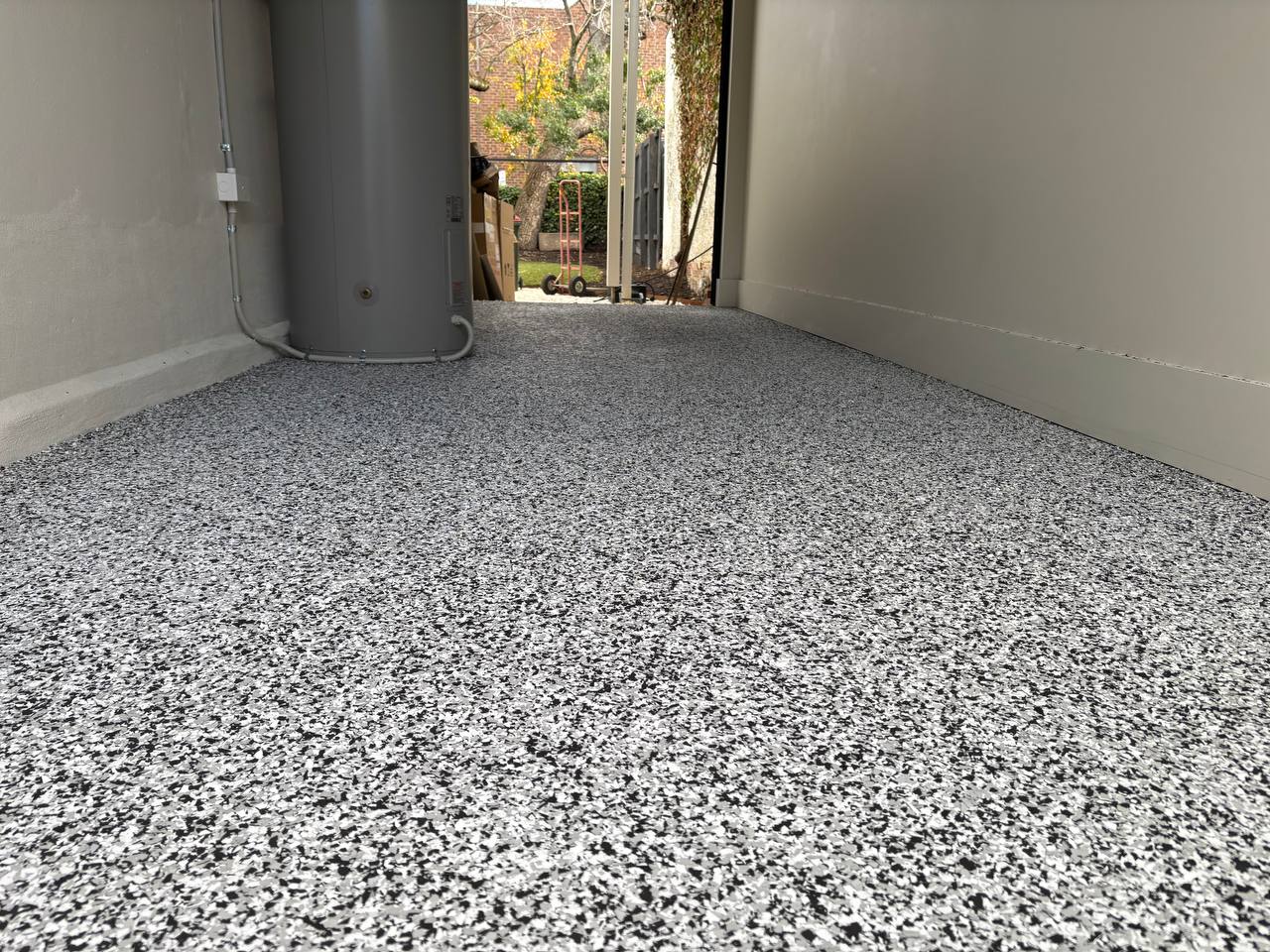
We get asked about polyaspartic a lot more than we did even two years ago. Most of the time the question is really “should I get the fast one or the epoxy one?” — and that framing is where a lot of the confusion starts. So let’s untangle it properly before comparing the two on the things that actually matter for a garage: cure time, UV stability, durability, and cost.
What polyaspartic actually is (and isn't)
Polyaspartic is a type of polyurea — a fast-curing resin chemistry that’s applied as a topcoat far more often than as a full floor system on its own. In our experience, when someone says they’ve had a “polyaspartic floor” installed, what usually sits underneath is a standard epoxy base coat (and often a flake or quartz broadcast layer) with a polyaspartic topcoat sealing it, rather than polyaspartic used through the entire build.
That distinction matters because it changes what you’re actually comparing. Epoxy and polyaspartic aren’t always rival systems — they’re often the same floor, with polyaspartic doing the topcoat’s job instead of a second epoxy topcoat. The genuine either/or decision is usually: epoxy base + epoxy topcoat, versus epoxy base + polyaspartic topcoat. Some installers do run polyaspartic as a thin standalone coating direct to concrete, but for a garage that sees a daily-driver vehicle, we don’t recommend that — it doesn’t have the film build to handle the wear the way a proper epoxy base coat does.
Worth knowing: if a quote says “full polyaspartic system” with no epoxy base coat mentioned, ask what the total dry film thickness is and how it’s built up. A thin single-coat polyaspartic job is a different product to a layered epoxy system, even though both can look glossy on day one.
Chemically, the reason polyaspartic behaves so differently comes down to reaction speed. Epoxy cures through a relatively slow reaction between a resin and a hardener, which is exactly what gives installers the working time needed to roll it out evenly across a garage floor. Polyaspartic is an aliphatic polyurea — a much faster-reacting chemistry — which is what gives it the rapid cure, but also means it has to be applied quickly and skilfully within a short working window. That’s part of why polyaspartic application is generally left to experienced installers rather than a DIY-friendly product; get the timing wrong and you can end up with roller marks or lap lines that set before they can be smoothed out.
Cure time: the biggest practical difference
This is where polyaspartic genuinely earns its reputation. A standard epoxy system needs roughly 24 to 72 hours before the floor can take foot traffic safely, and closer to 5–7 days before it’s ready for a vehicle to sit on it, because the resin needs time to fully cross-link and reach its working hardness. Polyaspartic topcoats can be tack-free within a couple of hours and often trafficable the same day, which is the whole reason the “one-day floor” marketing exists.
For most homeowners doing a garage that isn’t the only place a car can go, a few days off the floor isn’t a big deal. Where it matters more is commercial or high-turnover settings — a workshop that can’t afford to lose a bay for a week, for example — which is part of why polyaspartic topcoats have found a real home in commercial garage flooring projects.
It’s also worth separating “cures fast” from “installs fast.” Surface prep, grinding, crack repair, and base coat application take the same amount of time regardless of which topcoat goes on last. Polyaspartic shortens the back end of the job, not the whole thing.
UV stability and yellowing
Standard epoxy resin isn’t UV stable — it will yellow or amber slightly over time when exposed to sunlight, which is why light-coloured epoxy floors near a west-facing roller door in Bentleigh or Mitcham can develop a faint warm tinge after a few years where direct sun hits the slab. It’s cosmetic, not structural, and it’s slow, but it’s real.
Polyaspartic is genuinely more UV stable than standard epoxy, which is one of its real, non-marketing advantages. If your garage gets a lot of direct sun through an open door, large windows, or a north-facing aspect — fairly common in newer builds around Vermont and the eastern suburbs — a polyaspartic topcoat over the epoxy base will hold its colour better over the long run than an epoxy topcoat will.
That said, most garages don’t get sustained direct UV exposure the way an outdoor patio does, because the roller door is shut most of the time. For a fully enclosed garage, this advantage is real but often smaller in practice than it sounds on paper.
Durability and build thickness
| Factor | Epoxy (Base + Epoxy Topcoat) | Epoxy Base + Polyaspartic Topcoat |
|---|---|---|
| Cure to foot traffic | 24–72 hours | As little as 2–6 hours |
| Cure to vehicle traffic | 5–7 days | Often next day |
| UV stability | Can amber slowly in direct sun | Better long-term colour hold |
| Track record in Melbourne garages | Long-established | Newer, growing fast |
| Typical cost | Baseline | Moderate premium for the topcoat |
Cost comparison
A polyaspartic topcoat generally adds a moderate premium over an equivalent epoxy topcoat, largely because the material itself costs more and needs a faster, more precisely timed application process. It isn’t a dramatic jump for most single garages, but it’s not free either. The base coat, prep work, and any flake or quartz broadcast are priced the same regardless of which topcoat goes on top, so the polyaspartic premium sits specifically on that final layer.
We’d always rather walk you through how pricing is actually calculated for your specific slab than quote a flat number here — garage size, floor condition, and the system you choose all move the total. If speed of turnaround isn’t a factor for you, that premium is easy to skip without losing meaningful floor performance.
Application conditions and Melbourne's climate
Melbourne’s swing-in-a-day weather is worth factoring into the timeline conversation, whichever system you choose. Epoxy cure times are sensitive to temperature and humidity — cold, damp conditions slow the chemical reaction down, which is part of why we plan epoxy installs around milder, more settled weather windows rather than the middle of a cold, wet week. A slower cure isn’t a defect, but it does mean the “24–72 hour” window can stretch out a little further in winter.
Polyaspartic is generally less fussy about ambient temperature during cure because the reaction itself is so fast, which is one of the reasons it’s gained ground for jobs booked in tighter or less predictable weather windows. It’s still not immune to the elements — very high humidity during application can affect finish quality — but the margin for error on timing is narrower in a different way: get the application window wrong and the material can start setting mid-application rather than simply curing more slowly.
Which one suits your garage
Neither system is universally “better” — they solve slightly different problems.
🏠
Standard daily-driver garage
Epoxy base and topcoat is proven, cost-effective, and more than durable enough for normal residential use.
☀️
Sun-exposed garage
A polyaspartic topcoat is worth the premium if the floor gets real direct sunlight for meaningful parts of the day.
⏱️
Time-pressured turnaround
Polyaspartic's fast cure suits commercial spaces or households with no second place to park.
💰
Budget-first projects
Skipping the polyaspartic topcoat and staying with a full epoxy system is a legitimate way to control cost.
If you’re weighing this decision alongside broader questions like how long your floor should last or how build thickness affects performance, it’s worth reading up on how coat thickness is actually specified before locking in a system — the topcoat choice is only one part of the overall spec. And if you’re still deciding between a coated floor at all versus painting the slab, our epoxy vs garage floor paint comparison covers that more fundamental question.
Standards Australia doesn’t publish a standard specific to “epoxy vs polyaspartic” chemistry, but general coating performance criteria — including slip resistance, which both systems can be formulated to meet — sit under the broader product and safety standards published by Standards Australia. Whichever system you land on, ask your installer which slip additive is being used in the final coat, not just which resin.
Be wary of: quotes that use “polyaspartic” as a premium buzzword without explaining the actual build-up underneath. The chemistry of the topcoat is one input into a good floor — surface prep and base coat quality matter at least as much, regardless of which topcoat you choose.
Honestly, most Melbourne homeowners doing a single or double garage do perfectly well with a standard epoxy system, and reserve the polyaspartic upgrade for garages with genuine sun exposure or turnaround pressure. The best way to know which applies to your slab is to have someone look at the space, the light it gets through the day, and how you actually use it — that’s a five-minute conversation on-site, not something a blog post can decide for you.
Frequently Asked Questions
Is polyaspartic better than epoxy for a garage floor?
Not universally — polyaspartic cures faster and resists UV yellowing better, but epoxy offers proven film build and a longer local track record. Most residential garages do very well with a standard epoxy system; polyaspartic earns its premium mainly in sun-exposed or time-pressured jobs.
How long does polyaspartic take to cure compared to epoxy?
A polyaspartic topcoat can be tack-free within a few hours and often ready for vehicle traffic the next day, while a standard epoxy system typically needs 24–72 hours before foot traffic and 5–7 days before a car should sit on it.
Does epoxy yellow over time in a Melbourne garage?
Standard epoxy can develop a slight amber tinge where it gets sustained direct sunlight, such as near a west-facing roller door, though it’s a slow cosmetic change rather than a structural issue. Polyaspartic topcoats resist this better if UV exposure is a real factor in your garage.
Is a "polyaspartic floor" actually just epoxy underneath?
In most residential installs, yes — what’s usually sold as a polyaspartic floor is an epoxy base coat with a polyaspartic topcoat, not polyaspartic used through the entire build. It’s worth asking your installer to confirm the full layer build-up before assuming otherwise.
Does a polyaspartic topcoat cost more than an epoxy topcoat?
Yes, typically a moderate premium, mainly because the material and the faster, more time-sensitive application process cost more. The base coat and prep work underneath are priced the same regardless of which topcoat you choose.
Which system is better for a daily-driver garage in Melbourne?
A well-built epoxy system handles daily vehicle use very well and is the more cost-effective default. A polyaspartic topcoat is worth considering if your garage gets strong direct sunlight for much of the day or you need the floor back in service quickly.
Get your free on-site quote
We visit your garage, assess your slab, discuss your finish options, and give you a detailed written quote — specific to your floor, not a generic estimate. No call-out fee, no obligation.