
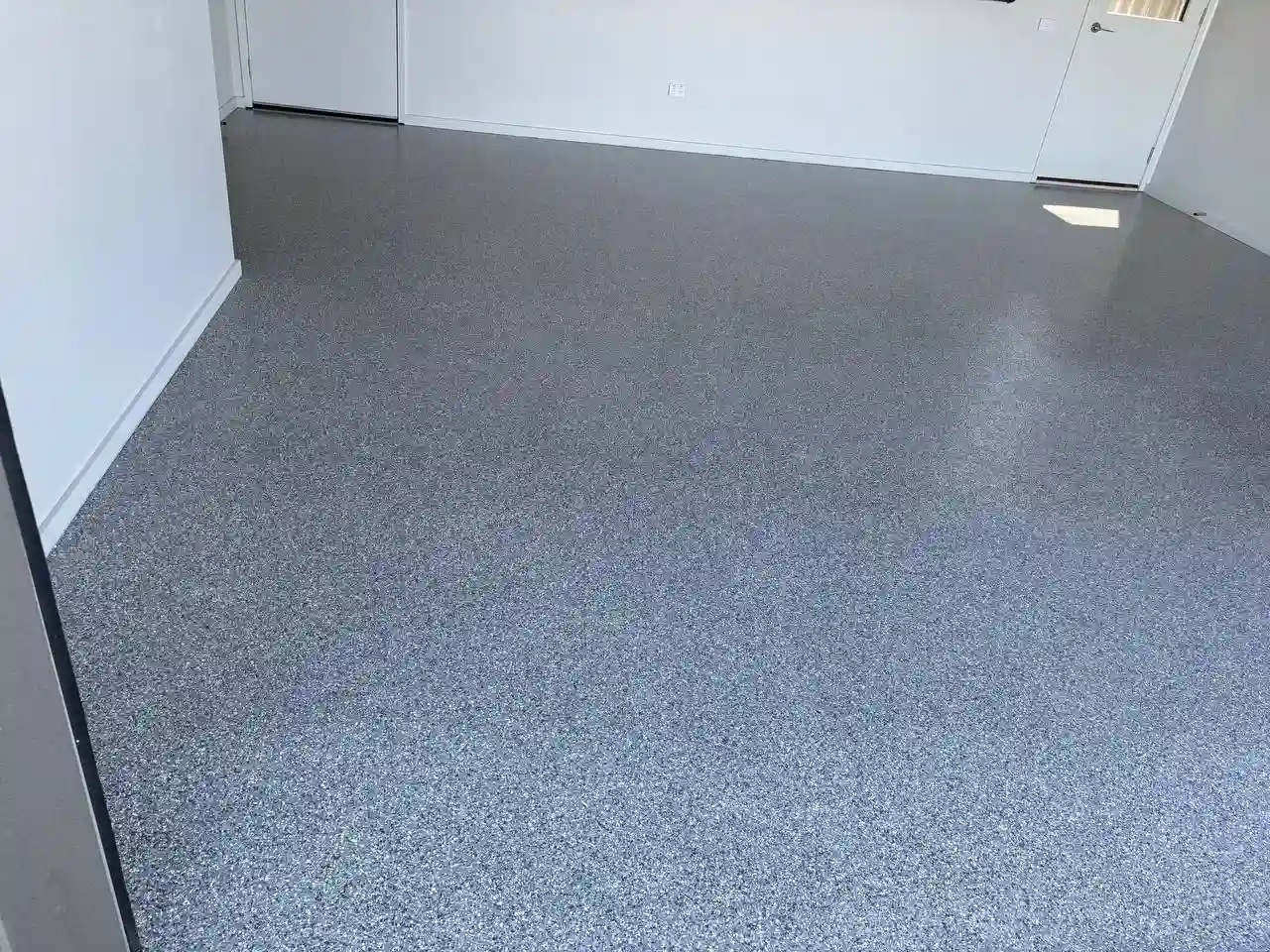
A good number of the calls we get start the same way: someone has an old, failing coating on their garage floor — usually a hardware-store paint job or a tired epoxy from years back — and they’ve already assumed it needs to be jackhammered out before anything new can go down. Almost always, it doesn’t. Removal is a grinding job, not a demolition job, and whether you even need it depends more on the existing coating’s condition than most people expect.
The assumption we hear most often
We understand where the assumption comes from — an old coating that’s peeling, bubbling or flaking looks like it’s failed catastrophically, and it’s a natural leap to think the only fix is starting from bare concrete again, the hard way. In reality, “removal” in this trade almost always means mechanically grinding the old coating off the surface of the slab, not breaking up the concrete itself. The slab underneath is untouched; only the thin coating layer on top comes off.
How diamond grinding removal actually works
Diamond grinding uses a floor grinder fitted with diamond-segmented discs to mechanically abrade the old coating off the concrete, working back to a clean, sound substrate. It’s the same core equipment used to prepare bare concrete before a first-time epoxy install, just run for longer and with more aggressive discs when there’s an existing coating to cut through.
- Coarse pass: aggressive diamond segments cut through the bulk of the old coating.
- Progressive passes: finer discs clean up residue and profile the concrete surface so a new system can bond properly.
- Dust extraction: a shrouded grinder connected to an industrial vacuum keeps the job largely dust-controlled, which matters in an attached garage.
- Crack and defect check: once the old coating is off, the bare slab is inspected for cracks or damage that were hidden underneath it.
This is also the point where problems that caused the original coating to fail — like a crack, a moisture issue, or poor original prep — become visible and can be properly addressed before anything new goes down. It’s genuinely useful information, not just a cost.
What affects removal cost
Three things drive removal cost more than anything else, and none of them are visible just from looking at the floor from a standing height.
Coating type
Number of layers
Adhesion strength
Floor size and access
How long removal actually adds to the job
Removal doesn’t just affect cost, it affects timeline, and that’s often the more immediate concern for a household with one car and one garage. Grinding off an old coating typically adds one to two extra days to a project compared with coating bare, previously-uncoated concrete, depending on the coating thickness and how many passes are needed to fully clean the surface back. Dust extraction adds a bit of time too, since a properly shrouded grinder connected to an industrial vacuum works more slowly than an uncontrolled one, but it’s a trade-off worth making in an attached or enclosed garage.
Where a floor has multiple old layers — say, an original coating plus one or two DIY recoats over the years that were never removed first — the grinding stage takes noticeably longer, because each layer has to be cut through in turn. This is one of the reasons we always want to see the floor in person rather than quote removal sight-unseen: a floor’s coating history isn’t always obvious from a phone photo, and layer count is one of the biggest swing factors in both time and cost.
Rough cost ranges
Because those factors vary so much job to job, we’re always cautious about quoting a single number without seeing the floor — but as a general guide, removal work for a typical single or double garage usually sits as an added cost on top of a standard reinstall, rather than as a separate large project of its own. A thin, failing paint coating is generally the cheapest and fastest thing we grind off; a thick, well-adhered multi-layer epoxy system from a previous quality install takes longer and costs more to remove, somewhat ironically because it was installed well in the first place.
For the clearest answer, we’d rather look at how pricing is actually calculated for your specific floor than give you a number that doesn’t reflect your coating type or slab size. Our guide on how to get an accurate quote explains what we need to see on-site to price removal and reinstall together properly.
Recoat vs strip and reinstall
This is the part that surprises people most: full removal isn’t always necessary. If an existing coating is sound — well-bonded, not delaminating, just tired-looking, faded, or scuffed — a fresh topcoat can often be applied directly over it after the right surface preparation (scuff-sanding and a thorough clean), without grinding the original layer off at all. This is meaningfully cheaper and faster than a full strip and reinstall.
Where full removal genuinely is needed is when the existing coating is actively failing — peeling, bubbling, or lifting in sheets — because a new coating applied over a failing one will simply fail again, often faster than the first time. Our guide on common causes of peeling and bubbling covers why coatings fail in the first place, which is usually the same underlying issue (moisture, poor original prep, or a coating applied over dust or contamination) that needs to be resolved before recoating, not just painted over again.
| RECOAT OVER EXISTING | STRIP AND REINSTALL | |
|---|---|---|
| When it applies | Existing coating is sound, just worn or dated | Existing coating is peeling, bubbling or delaminating |
| Prep required | Scuff-sand and clean | Full diamond grinding to bare concrete |
| Relative cost | Lower | Higher |
| Fixes underlying failure cause? | No — only appropriate if there wasn’t one | Yes — exposes and allows repair of the real cause |
Rule of thumb: if you can press a screwdriver edge or fingernail under a lifted section and pop more of the coating off easily, it’s failing and needs full removal. If it’s scratched and dull but firmly stuck down everywhere, a recoat is worth investigating first.
What removal often uncovers
Because removal exposes bare concrete that’s been hidden under a coating for years, sometimes a decade or more, it’s not unusual to find things the original coating was masking. Hairline cracks that developed after the first install, patches of efflorescence pointing to a moisture issue, or an uneven slab from an older, less precise original pour can all be sitting under a coating that looked perfectly fine from above.
None of this is cause for alarm — most of it is straightforward to address as part of the reinstall (crack repair, moisture mitigation primers, or self-levelling compound where the slab genuinely needs it) rather than a separate, unplanned expense. But it’s worth going into a removal job expecting the quote to potentially adjust once the old coating is off and the real condition of the slab is visible, rather than assuming the original quote is locked in regardless of what’s underneath. A transparent contractor will explain this possibility upfront rather than surprising you with it midway through the job.
Getting it properly assessed
The only reliable way to know whether your floor needs a full strip or just a recoat is a proper on-site look — tapping and checking adhesion across the floor, not just a visual glance from the doorway. We’d rather assess it honestly and tell you a recoat will do the job than sell you a full removal you don’t need, and equally we won’t recommend recoating over a floor that’s clearly on its way to failing again.
If you’re weighing this decision against a full garage refresh, it’s also worth reading about what a typical transformation actually looks like once an old, tired floor is properly redone, and our note on how coat thickness is specified if you’re deciding what system to install once the old coating is off.
Worth checking: under Victorian consumer law, a contractor should be clear in writing about what’s included in a removal and reinstall quote before work starts. See Consumer Affairs Victoria for general guidance on your rights around trade quotes and contracts.
Frequently Asked Questions
How much does it cost to remove an old epoxy garage floor coating in Melbourne?
It depends mainly on the coating type, how many layers are present, and how well-bonded it is, so costs vary considerably between jobs. A thin failed paint coating is generally cheaper to remove than a thick, well-adhered multi-layer epoxy system.
Do you have to jackhammer out an old garage floor coating?
No — removal is almost always done by diamond grinding the coating off the surface of the slab, not by breaking up the concrete itself. The slab stays intact; only the thin coating layer on top is ground away.
Can you recoat an epoxy floor without stripping it first?
Yes, if the existing coating is sound and well-bonded rather than peeling or lifting. In that case a scuff-sand and clean is usually enough preparation, which is significantly cheaper than a full strip and reinstall.
How do I know if my garage floor coating needs full removal?
If sections are peeling, bubbling, or lift easily when you get a fingernail or screwdriver edge under them, the coating is failing and needs full removal. If it’s just dull or scratched but firmly stuck down everywhere, a recoat may be enough.
Does removing an old coating damage the concrete slab underneath?
No, properly done diamond grinding removes only the coating layer and lightly profiles the concrete surface to help a new coating bond, it doesn’t damage the structural slab. Any cracks or defects found once the old coating is off were already there, just hidden.
Is it cheaper to strip and reinstall, or just recoat over an old floor?
Recoating over a sound existing coating is cheaper and faster than a full strip and reinstall, since it skips the diamond grinding stage entirely. It’s only appropriate when the existing coating isn’t actively failing.
Not sure if your floor needs stripping or just recoating?
We’ll assess adhesion on-site and give you an honest answer before we quote either option.