
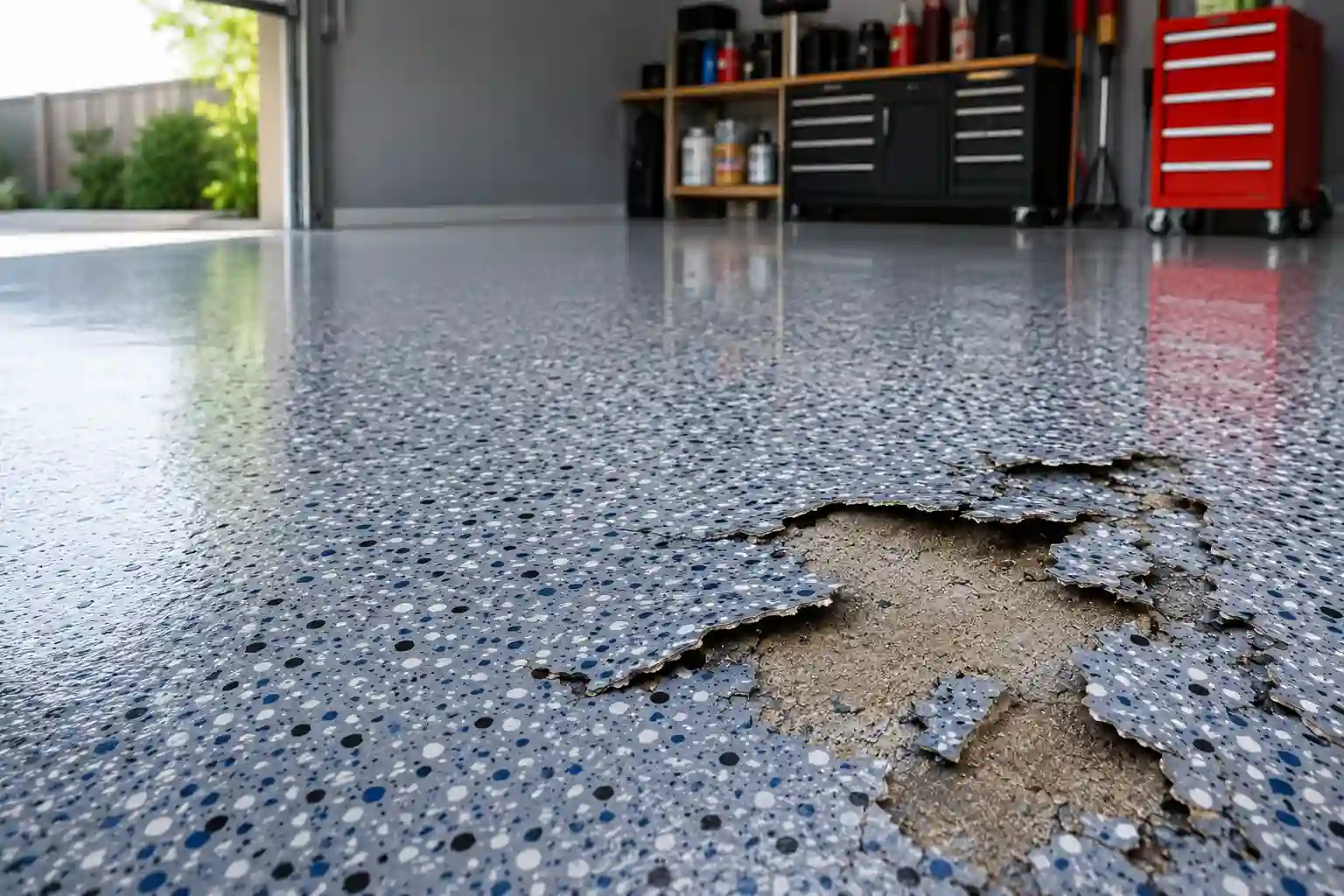
Most epoxy floor failures aren’t random bad luck — they trace back to one of a handful of causes, and almost all of them are avoidable, and fixable. Here’s how to tell what’s actually gone wrong.
If you’re reading this standing over a garage floor that’s lifting at the edges, bubbling in patches, or gone patchy white in places — you’re not the first, and it’s very rarely as bad as it looks. In almost every callout we do for a failing epoxy floor, the cause turns out to be one of three things: moisture, preparation, or product. The good news is all three are diagnosable, and none of them require tearing up the concrete underneath.
This isn’t a scare piece to sell repairs. It’s the same checklist we actually use on site, so you can work out roughly what’s happened before anyone turns up with a grinder.
The problems we get called out for most
🫧
Bubbling
🪶
Peeling / lifting
☁️
White haze / blushing
🪵
Cracking
🟡
Yellowing
🛞
Hot tyre pick-up
Why it actually happens
Moisture in the slab
This is the single biggest cause of bubbling and peeling. Concrete is porous, and if moisture is moving up through the slab — common in older Melbourne garages without a proper vapour barrier underneath — it has nowhere to go once it’s sealed under epoxy. It pushes the coating up from below instead. A proper installer moisture-tests the slab before ever opening a tin; if that step was skipped, this is usually the reason.
Skipped or rushed surface preparation
Epoxy doesn’t stick to a slab, it mechanically keys into it. Acid etching alone (rather than diamond grinding) leaves a shallower, less reliable key, which is exactly why common DIY mistakes that cause this almost always trace back to preparation being the step that got shortened to save time.
The wrong product for the job
Thin, water-based DIY kits are more prone to blushing and early wear than 100% solids systems, particularly in a garage that sees regular vehicle traffic. This is also where how a fair repair quote is priced tends to come up — the cheapest original install is very often the one that ends up needing a redo.
Application conditions
Epoxy cures on a schedule, and Melbourne’s swings between a mild morning and a hot afternoon (or a cold, damp week in winter) can affect cure quality if the installer didn’t work around it. Rushed jobs booked regardless of weather are a common thread in blushing and soft-cure complaints.
Contamination on the slab
Old sealers, curing compounds, or oil that wasn’t fully stripped before coating will stop epoxy bonding properly in that exact spot — which is often why peeling shows up as isolated patches rather than across the whole floor.
Quick self-check: if the problem is patchy and near the garage door line, think moisture or contamination. If it’s a fine line that matches a crack in the concrete, that’s the slab moving, not the coating failing. If it’s soft or tacky anywhere, that’s almost always a cure or product issue.
Recoat, patch, or full replacement?
| WHAT YOU’RE SEEING | LIKELY FIX |
|---|---|
| Small, isolated bubbling or peeling patches | Localised patch repair — grind back the affected area only |
| General dulling, light wear, no lifting | Maintenance topcoat / recoat over the existing floor |
| Widespread bubbling or peeling across most of the floor | Full strip-back and reinstall — the bond itself has failed |
| Crack in the coating matching a slab crack | Slab crack repair first, then a localised coating fix |
We cover the general lifespan side of this — including how to tell if you need a recoat or a full replacement — in more detail in our floor lifespan guide, which is worth reading alongside this one if your floor is just ageing rather than actively failing.
What a genuine repair actually involves
- Diagnose first. Identify whether it’s moisture, prep, product, or the slab itself — this changes the whole repair approach.
- Grind back properly. The failed area (or the whole floor, if it’s widespread) gets ground back to sound concrete, not just sanded or patched over the top.
- Retest for moisture. Skipping this step is exactly how the original floor failed — it doesn’t get skipped twice.
- Reapply the correct system. Matched to how the garage is actually used, not the cheapest option available.
- Put a real warranty behind it. A repair without a warranty is just betting the same thing doesn’t happen again.
Your rights if a floor fails early
If your current floor was installed by another contractor and it’s failed well before the lifespan you were quoted, it’s worth knowing that under Australian Consumer Law, services have to be provided with acceptable care and skill — a floor peeling within a year or two of installation is generally not “wear and tear.” Consumer Affairs Victoria has guidance on pursuing a remedy directly with the original installer before paying for a second job out of pocket.
How to avoid this next time
- Ask directly whether the slab will be moisture-tested and diamond ground before any product goes down — not just “prepped.”
- Get the system and solids content in writing, not just “epoxy” — this is covered in what to expect from an accurate on-site quote.
- Choose a finish that suits how the garage is actually used — our guide to choosing your finish and colour covers how flake blends and solid colours wear differently over time.
- Get a written warranty that names what’s covered — not just a verbal assurance.
Frequently Asked Questions
Why is my epoxy garage floor peeling?
Almost always one of three causes: moisture trapped under the coating, insufficient surface preparation before installation, or a lower-grade product that wasn’t suited to the garage’s actual use.
Can a peeling epoxy floor be repaired without redoing the whole garage?
If the peeling is isolated to a small area, yes — a localised patch repair is usually enough. Widespread peeling across most of the floor generally means the whole surface needs to be ground back and reinstalled.
Why is my epoxy floor turning white or hazy?
This is commonly called blushing, and it’s typically caused by moisture or humidity affecting the coating during application or curing, rather than anything happening after installation.
Is a cracked epoxy floor a sign of a bad installation?
Not necessarily — if the crack in the coating lines up with a crack in the concrete slab underneath, it’s the slab moving, not a coating defect. It still needs fixing, but the cause is structural, not installation quality.
How long after installation should an epoxy garage floor start failing, if it's going to?
Most moisture and preparation-related failures show up within the first 6–18 months. A floor that’s lasted several years before showing wear is usually just reaching the natural end of its lifespan rather than failing.
Will my original installer have to fix a failed epoxy floor for free?
If the floor failed well within its expected lifespan, Australian Consumer Law generally requires services to be carried out with acceptable care and skill — Consumer Affairs Victoria can advise on pursuing a remedy directly with the original installer.
Get your free on-site quote
We visit your garage, assess your slab, discuss your finish options, and give you a detailed written quote — specific to your floor, not a generic estimate. No call-out fee, no obligation.