
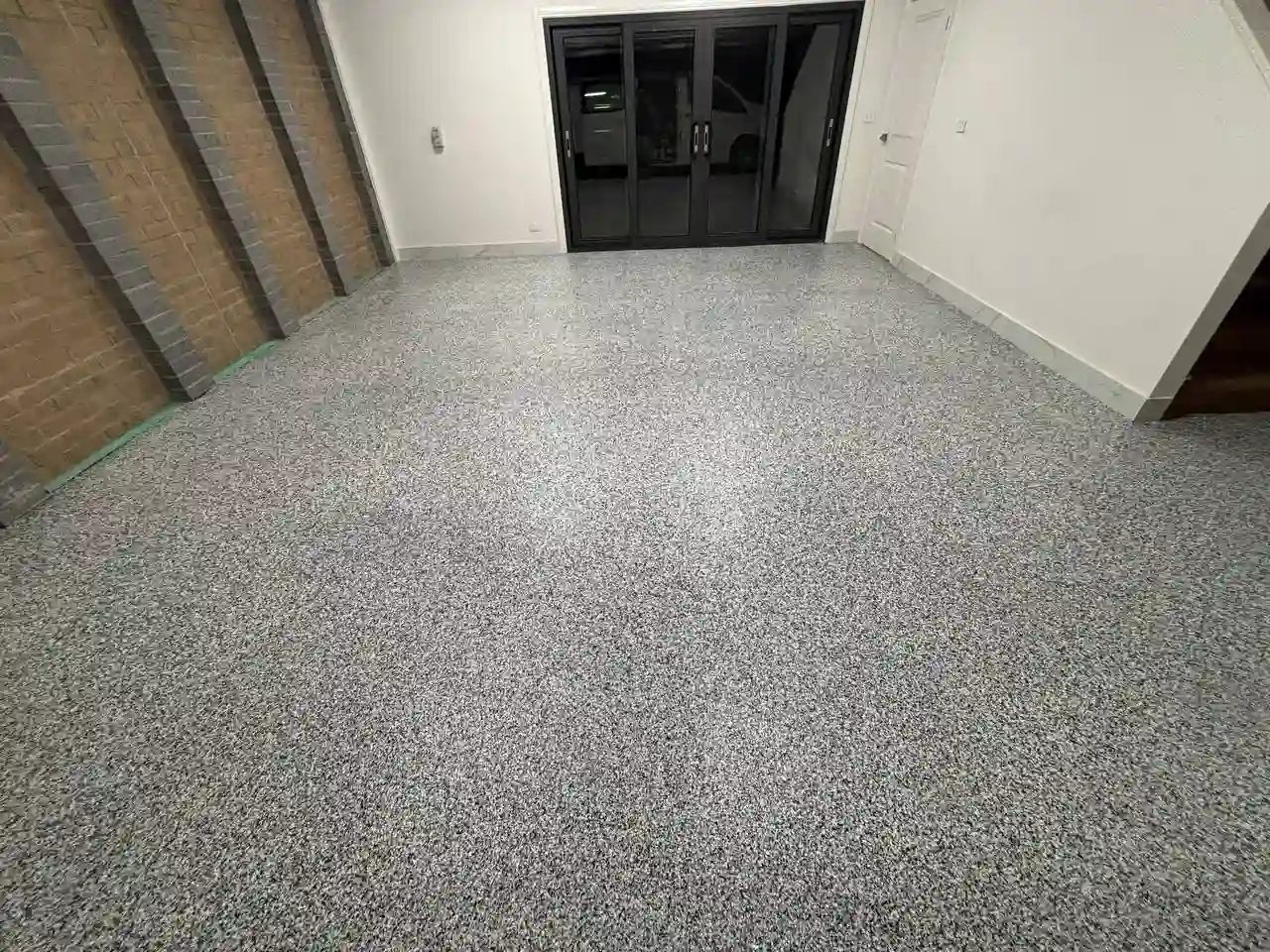
This comparison comes up a lot from people who’ve seen both options at a hardware store or online and want an honest answer rather than a sales pitch for one side. We install epoxy for a living, so we’ll say upfront: interlocking tiles are a legitimate product with genuine advantages, and they suit some garages better than epoxy does. Here’s the honest breakdown.
Two genuinely different products
Interlocking garage tiles are typically PVC or rigid polypropylene squares, often around 40-50cm each, that click together over the existing concrete without any adhesive or chemical bonding. They sit as a loose-laid floating floor on top of the slab. Epoxy, by contrast, is a two-part resin system that chemically bonds to the concrete itself, becoming a permanent part of the floor rather than a covering laid over it.
That single structural difference — bonded versus floating — explains almost every other difference between the two, so it’s worth keeping in mind through the rest of this comparison.
Cost and installation
Tiles are the cheaper option upfront, and by a meaningful margin in most cases. They’re widely sold as a DIY product — no specialist tools, no cure time, no need to book a tradesperson. A reasonably handy person can tile a single garage floor in an afternoon.
Epoxy costs more upfront and needs professional surface preparation (grinding, moisture testing, crack repair) and a multi-day install and cure window. That said, the cost gap narrows when you compare like-for-like — a decent-quality tile product with proper prep still isn’t free, and a hastily-laid epoxy job without correct prep will fail early and cost more in the long run than either option done properly. If cost is your main driver, our guide on how pricing is actually calculated is a useful reality check on what goes into an epoxy quote, and our comparison of DIY vs professional installation covers the labour side of that gap in more detail.
Durability under a vehicle
This is where the floating-versus-bonded difference really shows up. A daily-driver vehicle puts repeated, concentrated load through four small tyre contact patches, and a heavier vehicle or a jack point multiplies that further. Because epoxy is chemically bonded to the slab, that load transfers straight through the coating into the concrete underneath — the coating itself isn’t carrying the structural load, it’s just protecting the surface.
Interlocking tiles, being a floating layer, can shift, flex, or in some cases pop out of their interlocking joints under a heavy or awkwardly-placed load — a jack stand, a low-profile trolley jack, or repeated turning of the front wheels while stationary (a common cause of scuffing and tile movement). Most tile products are rated for vehicle weight in normal rolling use, but they’re generally less forgiving than epoxy of point loads and repeated pivoting under weight.
Genuine risk point: if you plan to install a car hoist, jack stands for regular DIY servicing, or store a heavier vehicle like a 4WD or a trailer, get clarity on the tile product’s specific load rating before committing — this is exactly the scenario where the gap between the two options is widest.
Repairability: tile-by-tile vs seamless
| FACTOR | INTERLOCKING TILES | EPOXY COATING |
|---|---|---|
| Installation | DIY-friendly, no cure time | Professional install, multi-day cure |
| Upfront cost | Lower | Higher |
| Bond to slab | Floating, not bonded | Chemically bonded, permanent |
| Heavy point loads (jacks, hoists) | Can shift or pop under load | Handles well when properly specified |
| Repair method | Swap individual tile | Patch and blend affected area |
| Look | Visible grid of seams | Seamless, continuous surface |
| Removability | Easy — lift and take with you | Permanent, requires grinding to remove |
Moisture and what's happening underneath
One thing that rarely comes up until it’s a problem: a floating tile floor sits over the concrete without sealing it, which means any moisture vapour naturally moving up through the slab (common in older or poorly-vapour-barriered garages) can pass through and evaporate at the tile joints, generally without causing much visible issue for the tiles themselves. Epoxy, being a fully bonded, largely vapour-impermeable coating, needs that moisture situation properly assessed and, where necessary, managed before installation — otherwise trapped moisture pressure underneath a bonded coating is a genuine cause of the peeling and bubbling failures we cover in our peeling and bubbling guide.
This isn’t a reason to avoid epoxy — proper moisture testing before any install is a standard, solvable part of the process — but it does mean epoxy has a prep step that tiles largely sidestep. If you already know your garage has damp issues, that’s worth raising early in the conversation regardless of which flooring option you’re leaning towards.
Look, feel and cleaning
Tiles have a visible grid pattern of joints, which some people like (it reads as a “garage flooring” look) and others find breaks up the visual continuity of the room. Those joints also trap fine grit, dust and swarf over time — not a dealbreaker, but it does mean an occasional lift-and-clean-underneath if the garage gets genuinely dirty, which a fully seamless epoxy floor never requires.
Epoxy’s seamless surface is easier to keep clean day-to-day (a sweep and occasional mop, with no joints for grit to hide in) and gives a more finished, “part of the house” look rather than a garage-specific product feel. If look and low-maintenance cleaning matter to you, that continuity is a genuine point in epoxy’s favour — see choosing your finish and colour for how far that can be pushed. If you’d like the fuller case for epoxy specifically, our rundown of the full list of benefits covers it in more depth.
How each handles Melbourne's temperature swings
Plastic tile products expand and contract with temperature more noticeably than a bonded epoxy coating does, which matters in an uninsulated garage that swings from a cold overnight low to a hot, sun-baked afternoon through a Melbourne summer. Most quality interlocking tiles are engineered with enough flex in their interlocking joints to handle this movement without buckling, but a cheaper or poorly-installed product can develop a slight ripple or gap at the joints after a few extreme temperature cycles, particularly along a wall where the tiles are cut tight with no room to move.
Epoxy, being fully bonded to a large thermal mass (the concrete slab), experiences far less temperature-driven movement of its own — the coating essentially moves with the slab rather than as an independent layer. This is one of the quieter reasons epoxy tends to age more predictably over a hot Melbourne summer and a cold, damp winter than a floating tile floor does, on top of everything else already covered here.
Who each option actually suits
Renters or short-term occupiers
Heavy DIY workshop use
Owner-occupiers, long-term
Heavier vehicles, hoists or daily driving
Neither answer is universally right — it genuinely comes down to how long you’ll be in the property, how the garage gets used, and whether permanence or removability matters more to you. If you’re leaning towards epoxy after weighing this up, our residential garage epoxy service page covers what a proper install involves, and we’re always happy to book a free on-site assessment if you want a direct opinion on your specific garage rather than a general comparison.
It’s also worth reading our note on epoxy vs garage floor paint if hardware-store paint is a third option you’re weighing up alongside tiles — it sits in a different category again, closer to tiles on cost but without the removability.
A practical middle ground: some homeowners tile a small, high-abuse zone (a workbench area, a tool corner) while leaving the rest of a large garage bare or basic, without extending that logic across a whole daily-driver floor. It’s not common, but it’s a legitimate way to get tile-by-tile repairability exactly where it’s needed most.
Frequently Asked Questions
Are interlocking garage tiles as durable as epoxy?
Not quite under heavy vehicle use — tiles are a floating floor and can shift or pop under concentrated loads like jack stands or a heavy vehicle turning on the spot, while epoxy is chemically bonded and handles those loads more predictably. For lighter, general use, both hold up reasonably well.
Which is cheaper, epoxy or interlocking garage tiles?
Interlocking tiles are cheaper upfront and are widely sold as a DIY product with no professional installation needed. Epoxy costs more due to professional surface preparation and multi-day installation, though a quality tile job with proper prep narrows that gap somewhat.
Can you install interlocking garage tiles yourself?
Yes, that’s one of their main selling points — most interlocking tile products are designed for DIY installation without special tools or a cure period. Epoxy, by contrast, generally requires professional surface preparation and application to perform properly.
Do garage floor tiles trap dirt in the joints?
Yes, the seams between interlocking tiles can collect fine grit and dust over time, unlike a fully seamless epoxy floor. It’s not a major issue with regular sweeping, but it does mean an occasional lift-and-clean underneath for a genuinely dirty garage.
Is epoxy or tile flooring better for renters?
Interlocking tiles suit renters and short-term occupiers better because they’re removable and can be taken with you when you move. Epoxy is a permanent, bonded coating that isn’t practical to remove and reinstall elsewhere.
Can interlocking tiles handle a car hoist or jack stands?
It depends on the specific product’s load rating, but floating tile systems are generally less forgiving of concentrated point loads like jack stands than a bonded epoxy floor. If you’re planning a hoist or regular DIY servicing, check the tile manufacturer’s load rating carefully before choosing tiles.
Weighing up tiles vs epoxy for your garage?
We’ll give you a straight answer for your situation, even if that answer isn’t epoxy.